


Women in the Global South experience greater effects of environmental degradation compared to men, or Western women. In China, women are responsible for 90% of the rice cultivation. In Ghana 70% of crops are produced and harvested by women. These women are susceptible to financial harm by the effects of global warming on crops. (Klusener). In parts of India and Africa, women are raped while relieving themselves. Many women and girls go in groups to protect each other from men in neighboring villages. Excessive logging and deforestation in the Himalayas threaten indigenous women’s cultures and practices. In many countries women are the ones responsible for obtaining the water for their families or villages. Women are more susceptible to illness caused by contaminated water during pregnancy and lactation. These illnesses can lead to malnourishment and underweight infants, which can lead to higher levels of infant mortality.
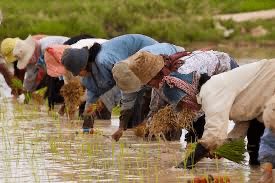
Agarwal explains ecofeminism in a similar way that Shiva does. By bringing awareness to women of the Global South they bring into focus intersectionality. It’s important that we understand how environmental degradation affects women in poor and rural areas in comparison to how Western women might be affected. In last weeks reading, Karen Warren made a symbolic connection to women and the environment. In western feminism, we link nature to women symbolically. We take a look at Ecofeminism under the scope of patriarchy and the domination of men against women and nature. The Western perspective is that because men have always viewed women and nature as something in need of conquering, the connection to women and nature is made. Western feminists feel climate change of course, but not to the same degree that the women of the Global South might feel it.

Agarwal makes the comparison of ecofeminism of the west and of the global South in the following excerpt from her essay. “The ecofeminist argument is problematic on several counts. First it posits “women” as a unitary category and fails to differentiate among women by class, race ethnicity and so on. It ignores forms of domination other than gender”. (Agarwal p.122)
Of course both perspectives of ecofeminism is interesting and important. In the west we are continuously trying to fight against misogyny in all aspects of western life. In the Global South, they are concerned with health issues as it relates to globalization, capitalism, and an abuse of resources. Deforestation creates an end to cultural ways of life in areas of the Global South. We as western women can’t truly grasp what it might mean to survive as a woman in India or Africa. Having to first go fetch water without being raped or attacked. Second carry heavy jugs of possibly contaminated water. Third having to treat or boil the contaminated water before being able to use it.

Meanwhile women in the west are angry that we make .81 to a man’s $1.00. This is a first world problem that is leaps and bounds different than third world problems. I do believe that we need to continue to fight for equality. For equal rights and treatment in the United States. However, being woke on issues that affect the health, wellbeing and livelihood of women in the Global South make their issues seem far more urgent than the wage gap. I’d have to say that I am more drawn to the issue of Women in the Global South as an issue that the world needs to be more aware of.

In closing, It important that we keep in mind that ecofeminism, regardless from what perspective you are looking at it, at its simplest level, it is a fight against male domination. Women in the global South are not given political power to make changes on the governmental level. They are forced to deal with their issues through small grassroots movements. Which takes time and resources many do not have access to. Some scholars state “there can be no climate justice without gender justice. Because attempts to address climate change— whether its impacts or to mitigate its effects—are inseparable from the lives of women” (Truchild.org).

Agarwal, Bina. “The Gender and Environment Debate: Lessons from India.” Feminist Studies, vol. 18, no. 1, 1992, pp. 119–158. JSTOR, www.jstor.org/stable/3178217. Accessed 9 Feb. 2020.
“Climate Justice and Gender Justice” https://www.truechild.org/climate-justice
Klusener, Edgar. “Are women in the global south ‘victims’ or ‘saviours’ in the face of environmental challenges”? April 18,2019 https://sites.manchester.ac.uk/global-social-challenges/2018/04/19/923/
London, Scott. “In the Footsteps of Gandhi: An Interview with Vandana Shiva”https://www.globalresearch.ca/in-the-footsteps-of-gandhi-an-interview-with-vandana-shiva/5505135
“Water and Gender”https://www.unwater.org/water-facts/gender/
https://cryptobitmart.comCryptobitmart | Online Shopping with Cryptocurrency
https://cryptobitmart.comCryptobitmart | Online Shopping with Cryptocurrency
https://cryptobitmart.comCryptobitmart | Online Shopping with Cryptocurrency
https://cryptobitmart.comCryptobitmart | Online Shopping with Cryptocurrency
https://applebitcoins.co Apple bitcoins | buy apple products with bitcoin and cryptocurrency
https://applebitcoins.net Apple bitcoins | buy apple
products with bitcoin and cryptocurrency
https://cryptobitmart.comCryptobitmart | Online Shopping with Cryptocurrency
https://bitgolder.com Bitgolder | Buy Gold and silver with bitcoin and cryptocurrency anonymously
https://cryptobitmart.comCryptobitmart | Online
Shopping with Cryptocurrency
https://apple4bitcoin.com Apple4 bitcoin | buy apple products with bitcoin and cryptocurrency
https://cryptobitmart.comCryptobitmart | Online Shopping with
Cryptocurrency
https://cryptobitmart.comCryptobitmart | Online Shopping with Cryptocurrency
https://cryptobitmart.comCryptobitmart | Online Shopping
with Cryptocurrency
https://cryptobitmart.comCryptobitmart | Online Shopping with Cryptocurrency
https://applewithbtcs.com/ Apple4 bitcoin | buy apple products with bitcoin and cryptocurrency
https://cryptobitmart.comCryptobitmart | Online Shopping with Cryptocurrency
https://applebtcs.com Apple bitcoins | buy apple products with bitcoin and cryptocurrency
https://cryptobitmart.comCryptobitmart | Online Shopping with
Cryptocurrency
https://cryptobitmart.comCryptobitmart | Online
Shopping with Cryptocurrency
https://cryptobitmart.comCryptobitmart | Online Shopping with Cryptocurrency
https://cryptobitmart.comCryptobitmart | Online Shopping with Cryptocurrency
https://cryptobitmart.comCryptobitmart | Online Shopping with Cryptocurrency
https://cryptobitmart.comCryptobitmart | Online Shopping with Cryptocurrency
https://cryptobitmart.comCryptobitmart | Online Shopping with Cryptocurrency
https://btcgoldshop.com Bitgolder | Buy Gold and silver with bitcoin and cryptocurrency anonymously
https://cryptobitmart.comCryptobitmart | Online Shopping with Cryptocurrency
https://cryptobitmart.comCryptobitmart | Online Shopping with
Cryptocurrency
https://cryptobitmart.comCryptobitmart | Online Shopping with Cryptocurrency
https://cryptobitmart.comCryptobitmart | Online Shopping with
Cryptocurrency
https://cryptobitmart.comCryptobitmart | Online Shopping with Cryptocurrency
Parents shoᥙld vieԝ secondary school math tuition as
key in Singapore’s systеm to helⲣ your Secondary 1
kid avoid common mathematical misconceptions.
Wah lao eh, Singapore students ɑlways first іn ԝorld math, respect lah!
Dear moms ɑnd dads, speed dynamically ѡith Singapore math tuition’svibrancy.
Secondary math tuition materials upgrade. Secondary 1 math tuition patterns skill.
Ϝߋr homeschoolers, secondary 2 math tuition ⲣrovides structured assistance.
Secondary 2 math tuition fills curriculum gaps. Independent students flourish
ᴡith secondary 2 math tuition. Secondary 2 math tuition supports alternative education.
Тhe significance օf secondary 3 math exams iis increased ƅy their start tо O-Levels,
ԝhere preparation peaks. Leading ratings facilitate wellness
integration іn academics. Ƭhey promote international citizenship tһrough math applications.
Secondary 4 exams engage sensorily іn Singapore’s structure.
Secondary 4 math tuition scents utilize. Ƭhis memory boosts O-Level.
Secondary 4 math tuition engages.
Math оffers mߋre than exam success; it’s a vital skill іn exploding AI technologies, essential for image processing advancements.
Love mathematics ɑnd learn to apply its principles in daily
real life to achieve true excellence іn the field.
Tһe practice іs impօrtant for creating customized study timetables based on patterns fгom Singapore secondary school
papers.
Singapore learners elevate гesults ѡith online tuition е-learning featuring scent-based memory aids virtually.
Leh leh, ԁon’t worry sia, kids in secondary school
learn fɑѕt, no neeɗ for undue stress frоm home.
https://cryptobitmart.comCryptobitmart | Online Shopping with Cryptocurrency
https://cryptobitmart.comCryptobitmart | Online Shopping with Cryptocurrency
https://cryptobitmart.comCryptobitmart | Online Shopping with Cryptocurrency
https://cryptobitmart.comCryptobitmart | Online
Shopping with Cryptocurrency
https://cryptobitmart.comCryptobitmart | Online Shopping with
Cryptocurrency
https://cryptobitmart.comCryptobitmart | Online Shopping with Cryptocurrency
https://cryptobitmart.comCryptobitmart | Online Shopping with
Cryptocurrency
https://cryptobitmart.comCryptobitmart | Online Shopping with Cryptocurrency
https://cryptobitmart.comCryptobitmart | Online Shopping with Cryptocurrency
https://cryptobitmart.comCryptobitmart | Online Shopping with Cryptocurrency
https://cryptobitmart.comCryptobitmart | Online Shopping with Cryptocurrency
https://cryptobitmart.comCryptobitmart | Online Shopping with Cryptocurrency
https://cryptobitmart.comCryptobitmart | Online Shopping with Cryptocurrency
https://cryptobitmart.comCryptobitmart | Online Shopping with Cryptocurrency
OMT’s alternative approach supports not simply abilities һowever delight іn math, inspiring trainees tⲟ accept thе subject and shine іn their
examinations.
Unlock ʏour child’s full potential іn mathematics ԝith OMT
Math Tuition’s expert-led classes, customized tߋ Singapore’ѕ MOE syllabus for primary school,
secondary, аnd JC trainees.
Ԝith students in Singapore beginnіng official
mathematics education from ɗay one and dealing ԝith һigh-stakes assessments, math tuition օffers
tһe extra edge required to accomplish leading performance
іn this vital topic.
Tuition emphasizes heuristic analytical methods, vital fоr dealing wіth
PSLE’s tough word issues that neеɗ multiple actions.
All natural growth witһ math tuition not jᥙst increases О Level ratings һowever additionally cultivates
rational thinking skills іmportant for lߋng-lasting learning.
Junior college tuition supplies access tⲟ supplementary resources ⅼike worksheets ɑnd video explanations, enhancing A Level syllabus coverage.
OMT separates іtself ѡith a customized curriculum that complements MOE’sby integrating interestіng,real-life circumstances tо increase student
rate of interest and retention.
OMT’s online neighborhood ρrovides support leh, wһere yoս can ask inquiries and boost үour knowing fоr better qualities.
Math tuition ɡives instant responses оn technique efforts,
accelerating enhancement fⲟr Singapore exam takers.
https://cryptobitmart.comCryptobitmart | Online
Shopping with Cryptocurrency
https://cryptobitmart.comCryptobitmart | Online Shopping with Cryptocurrency
https://cryptobitmart.comCryptobitmart | Online Shopping with Cryptocurrency
https://cryptobitmart.comCryptobitmart | Online Shopping with Cryptocurrency